Pluralistic Ignorance: When Everyone Thinks They're the Only One Confused


Picture this: You're in a project meeting where the CTO explains a new technical architecture. Everyone nods along. The meeting ends, and you're left thinking, "I have no idea what half of that meant." But you don't say anything, because everyone else seemed to understand it perfectly.
However: Four other people in that meeting felt exactly the same way. They also didn't understand. They also stayed silent. They also assumed everyone else got it. This is pluralistic ignorance, and it's quietly destroying team effectiveness in organizations everywhere.
What Is Pluralistic Ignorance?
Pluralistic ignorance is a psychological phenomenon where individuals in a group privately reject a norm or belief but incorrectly assume that most others accept it. In simpler terms: everyone thinks they're the only one who doesn't get it, so nobody asks questions, and everyone continues to not get it.
This phenomenon was first identified by social psychologists Daniel Katz and Floyd Allport in the 1930s. Their research showed that people consistently misjudge what others think, often assuming greater consensus than actually exists. In work environments, this manifests as:
- Nobody understanding a decision, but everyone assuming others do
- Everyone finding a process inefficient, but believing they're alone in that view
- Multiple people confused by documentation, each thinking they're the only one struggling
- Teams working on unclear requirements, each person privately uncertain but publicly confident
"The person who admits confusion is doing the entire team a service. They're breaking pluralistic ignorance and creating permission for honest communication."
How Private-First Tools Amplify Pluralistic Ignorance
Modern workplace communication tools were supposed to make collaboration easier. Instead, many of them have created perfect conditions for pluralistic ignorance to thrive. Here's how:
1. Private DMs Hide Individual Confusion
When someone doesn't understand something, the instinct in private-first tools is to send a DM to a colleague or manager: "Hey, quick question about the architecture doc. What did they mean by 'event-sourced aggregates'?"
This seems efficient. One-on-one, quick answer, problem solved. But it has a devastating hidden cost: that question and answer exist in a silo that helps exactly one person.
Meanwhile, five other team members have the exact same question. They also send private DMs. The knowledgeable person answers the same question six times. Nobody realizes how widespread the confusion is. The documentation never gets clarified because leadership thinks everyone understands it.
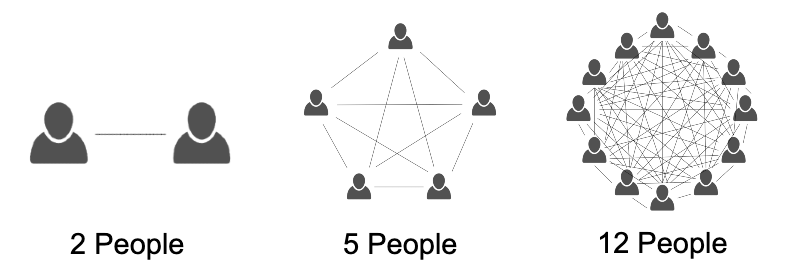
The chaos of private 1-on-1 communication: everyone asking the same questions separately
2. Group Chats Create False Consensus
Even in group chats, pluralistic ignorance persists. Someone asks in a team channel, "Does everyone understand the new deployment process?" Three people quickly reply with thumbs-up emojis. Five people say nothing, not because they understand, but because they don't want to be the only one who doesn't get it.
The silence is interpreted as agreement. The three visible responses create the appearance of consensus. The five confused people now believe they're in the minority. The team moves forward with a process that most people don't actually understand.
3. Private Channels Make Problems Invisible
Private channels create even more insidious dynamics. When project discussions happen in private channels, only the invited members can see what's happening. This creates two problems:
- Internal pluralistic ignorance: Within the private channel, individuals don't ask questions because they assume other channel members understand
- External information asymmetry: People outside the channel have no idea what's been discussed, what decisions were made, or what context exists
The result? New team members joining the project are completely lost. Adjacent teams making dependencies can't see the full picture. Leadership has limited visibility into where teams are actually stuck.
The Compounding Cost of Hidden Confusion
Pluralistic ignorance isn't just awkward, it has real, measurable costs that compound over time:
Productivity Loss
When people don't understand requirements, architecture, or processes, they work inefficiently. They make wrong assumptions. They build the wrong thing. They have to redo work. Every instance of hidden confusion is a small tax on productivity.
Multiply this across a team of 50 people, across dozens of projects, over months and years. The cumulative waste is staggering. Teams can spend 30-40% of their time working on things that wouldn't exist if confusion was visible and addressed early.
Quality Degradation
When people don't fully understand what they're building or why, quality suffers. Code is written without understanding the full context. Features are implemented without grasping user needs. Documentation is created without clarity on what needs explaining.
The downstream effects multiply: bugs, technical debt, user complaints, refactoring work. All because the original confusion was hidden behind private conversations and false consensus.
Innovation Stagnation
Perhaps the most insidious cost is what doesn't happen. When pluralistic ignorance dominates, people stop asking challenging questions. They stop proposing alternative approaches. They stop innovating.
After all, if you believe everyone else understands and agrees with the current approach, questioning it feels risky. "Maybe I'm just not getting it. Maybe I don't have the context they have." Better to stay quiet and go along with what seems like consensus.
"The most dangerous phrase in organizational life is: 'I thought everyone else understood, so I didn't want to look stupid.'"
How Transparent Channels Break Pluralistic Ignorance
Public-first communication doesn't just make information accessible, it fundamentally changes group dynamics in ways that combat pluralistic ignorance:
Visible Questions Normalize Not Knowing
When someone asks a question in a public channel, magic happens: everyone else who had the same question realizes they weren't alone. The simple act of one person admitting confusion creates permission for others to do the same.
This is why Cleariest's public-first channels are so powerful. When a junior developer asks, "Can someone explain what we mean by 'idempotent operations'?" in the #engineering channel, three things happen:
- They get an answer that helps them understand
- Five other people who had the same question also get clarity
- Everyone sees that asking questions is normal, valued, and helpful
Over time, this creates a culture where asking questions is seen as a sign of engagement and thoughtfulness, not incompetence.
Visible Answers Become Shared Knowledge
In private DMs, the same question gets answered repeatedly because each conversation is isolated. In public channels, questions get answered once and the answer becomes permanently available to everyone.
This doesn't just save time, it creates a living knowledge base that grows organically. Future team members can search the channel history and find answers to questions that were asked months ago. The knowledge compounds instead of being trapped in individual conversations.
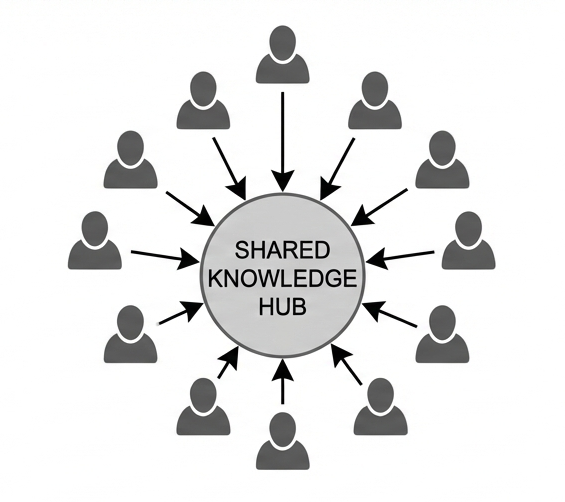
Public channels create a shared knowledge hub where everyone benefits from every question asked
Silence Becomes Suspicious, Not Confirming
Here's a subtle but critical shift: In public channels with good participation norms, silence is interpreted differently than in private channels or meetings.
When a leader asks, "Does this approach make sense?" in a public channel and gets only two responses from a 20-person team, it's immediately clear that consensus doesn't exist. The lack of visible engagement signals that people are either confused, busy, or disengaged, none of which indicate understanding or agreement.
This visibility forces better communication. Leaders learn to ask more specific questions: "What concerns do you have about this approach?" or "What's unclear that I should clarify?" These questions actively invite the expression of confusion and disagreement.
Patterns of Confusion Become Visible
When communication happens transparently, patterns emerge. If three people ask variations of the same question in a week, it becomes obvious that documentation needs improvement or that a concept needs better explanation.
In private-first tools, these patterns stay hidden. The expert answering DMs might notice they're getting the same question repeatedly, but leadership and the team never see it. The root cause (unclear communication or missing documentation) never gets addressed.
Practical Strategies for Your Team
Breaking pluralistic ignorance requires intentional culture-building. Here are practical approaches that work:
1. Leaders Model Question-Asking
The fastest way to normalize asking questions is for leaders to visibly ask them. When a CTO publicly asks, "I don't understand this part of the proposal. Can someone explain the trade-offs?" it sends a powerful message: not knowing everything is normal, even at senior levels.
This is especially important in technical organizations where imposter syndrome runs high. If the most experienced person in the room admits confusion, everyone else feels safer doing the same.
2. Actively Reward Public Question-Asking
Recognition matters. When someone asks a clarifying question in a public channel, acknowledge it: "Great question. I bet others were wondering the same thing." This explicit recognition reinforces that question-asking is valued behavior.
Some teams take this further with "Question of the Week" recognition or similar programs. The point isn't gamification, it's cultural reinforcement that curiosity and honesty are organizational values.
3. Default to "Ask in Public" Guidance
When someone sends a work-related question via DM, gently redirect: "Great question! Would you mind asking in #project-alpha so others can benefit from the discussion?"
This isn't about shaming private communication, it's about making public-first the default while preserving space for genuinely private conversations.
4. Track and Surface Repeated Questions
If you notice the same question coming up multiple times, even in public channels, take it as a signal that something needs clarification. Create documentation, update onboarding materials, or have a team discussion to address the root confusion.
Better yet, empower team members to do this themselves. When someone answers a question for the third time, encourage them to document it in a searchable format and share the documentation link in the channel.
5. Normalize "I Don't Know" and "Can You Clarify?"
Build explicit norms that make these phrases culturally acceptable:
- "I don't know" followed by "but I'll find out" is better than false certainty
- "Can you clarify what you mean by X?" is a sign of engagement, not ignorance
- "I'm confused about Y" is valuable feedback about communication clarity
Write these norms into team agreements. Reference them in onboarding. Model them in leadership behavior. Make them part of your organizational identity.
The Cultural Shift Required
Breaking pluralistic ignorance isn't primarily a tools problem, it's a culture problem. You can have the best transparent communication platform in the world, but if your culture punishes questions or rewards false confidence, pluralistic ignorance will persist.
The cultural shift requires three foundational elements:
1. Psychological Safety
People need to trust that asking questions won't result in judgment, mockery, or career consequences. This trust is built through consistent, repeated demonstrations that curiosity is valued and confusion is treated as a problem to solve together, not a personal failing.
2. Transparent Defaults
Make public communication the default, with privacy as the exception. This isn't about eliminating private conversations, it's about establishing that work-related discussions happen visibly unless there's a specific reason for privacy.
3. Recognition of Contribution
Asking good questions, sharing knowledge, and helping others understand are valuable contributions that deserve recognition. When these behaviors are celebrated, they increase. When they're ignored or taken for granted, they decrease.
"Organizations that break pluralistic ignorance don't just communicate better. They think better, decide better, and build better."
What This Looks Like in Practice
Let me paint two contrasting pictures:
Team A: Pluralistic Ignorance Dominates
A new feature gets proposed in a meeting. The proposal is complex and somewhat unclear. Nobody asks questions because everyone assumes others understand. The team builds the feature based on different interpretations of unclear requirements. Three weeks later, integration reveals the inconsistencies. Blame ensues. Nobody admits they were confused from the start because that would mean admitting they should have spoken up.
Team B: Transparency Breaks the Pattern
A new feature proposal gets shared in #product-planning. Within hours, three people have asked clarifying questions in the thread. The product manager realizes the proposal wasn't clear and posts a revised version. Two engineers point out potential technical constraints. A designer suggests a simplification. The discussion is visible to everyone, including adjacent teams who realize this feature might affect their work. By the time implementation starts, the requirements are crystal clear because confusion was visible and addressed immediately.
Same feature complexity. Radically different outcomes. The difference? Team B made confusion visible and treated it as valuable feedback, not a personal failing.
The Long-Term Impact
Organizations that successfully break pluralistic ignorance experience compounding benefits:
- Faster onboarding: New team members can ask questions openly and access historical context without navigating political dynamics
- Better decisions: When confusion and disagreement are visible, decisions incorporate more perspectives and address actual concerns
- Higher quality output: When people truly understand what they're building and why, quality naturally improves
- Increased innovation: When questioning is normalized, people propose alternative approaches and challenge assumptions productively
- Stronger culture: Teams built on honest communication and mutual support retain talent and attract great people
None of this happens overnight. But it does happen, if you're intentional about building systems and culture that make confusion visible and valuable rather than hidden and shameful.
At Cleariest, we've designed our platform to combat pluralistic ignorance through public-first channels, visible discussion threads, and cultural nudges that encourage question-asking. We believe the best teams are the ones where everyone feels safe admitting what they don't know, because that's how real learning and collaboration happen.
Break the silence. Build transparency.
Create a workspace where confusion is visible and questions are valued.
Start Free TrialRelated Reading
Why public-first channels combat information silos and hidden knowledge.
Transparent Team CommunicationTools and practices for building a culture of openness.
Best Chat for Async TeamsWhy async-first teams need a different kind of chat tool.
Cleariest vs SlackHow Cleariest compares for teams that value transparency.