Public vs Private Channels: Why Transparency Wins
Most teams default to private channels and DMs without thinking about it. The result is knowledge silos, repeated questions, and an onboarding experience that feels like requesting security clearance. Here is why public-first channel design builds stronger, more transparent teams — and how to make the transition.
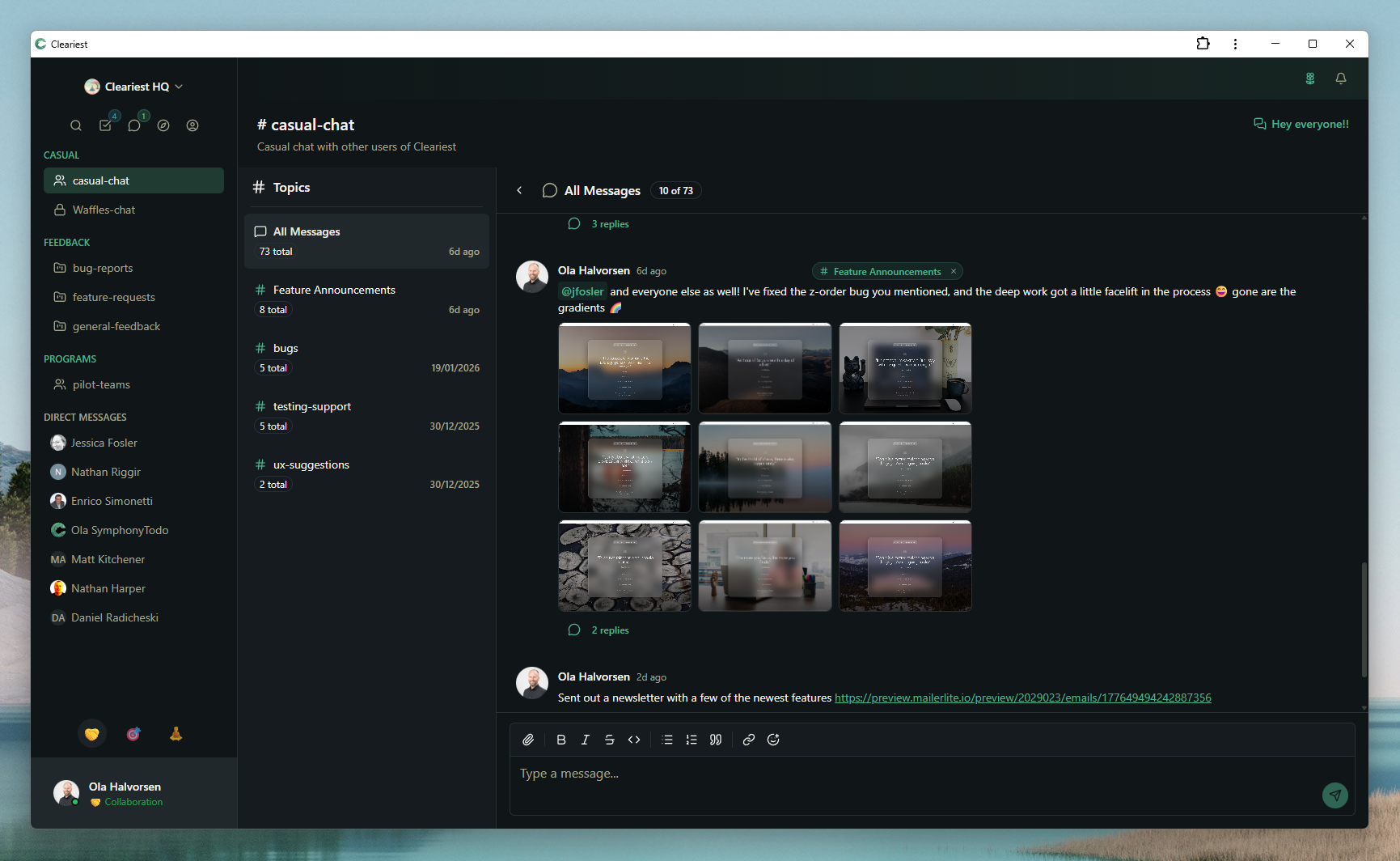
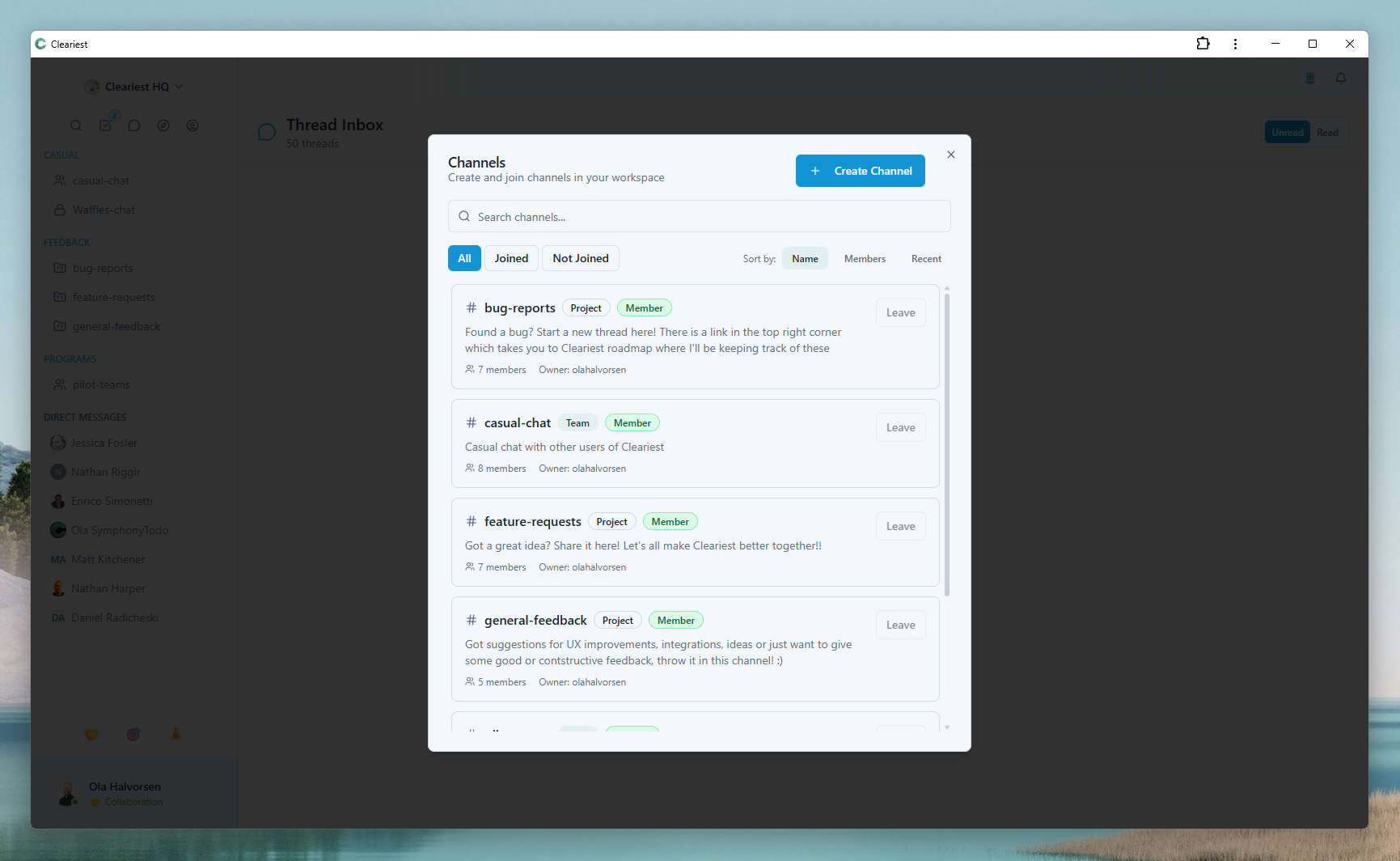
Screens from Cleariest's comparison pages showing public-first channel discovery and structure.
The Hidden Cost of Private-First Communication
Private channels feel safe. They feel organized. But when private becomes the default, teams pay a compounding tax on information access that most leaders never see on a dashboard. The costs are real, even if they are invisible.
Consider a typical engineering team of eight people. The backend team has a private channel. The frontend team has another. DevOps has one. Each project gets a private channel. Within six months, the workspace has 30+ private channels, and no single person has access to all of them. When a new engineer joins, they spend their first two weeks asking "can you add me to that channel?" instead of reading existing context.
Knowledge silos are the most expensive consequence. When a decision is made in a private channel, only the people in that channel know about it. Everyone else discovers it later — often by building something that contradicts the decision. A product manager makes a scope change in a private project channel. The designer, who was not added, continues working on the old scope. Two days of work are wasted before anyone notices.
The "can you add me?" culture is a symptom of a deeper problem: information is being treated as something to protect rather than something to share. In most teams, the vast majority of conversations are not sensitive. They are project updates, technical discussions, and coordination messages that everyone would benefit from seeing. Yet they are locked behind private channel walls by default, not by intention.
What Public-First Channels Actually Look Like
Public-first does not mean everything is public. It means public is the default, and private is the deliberate exception. Cleariest is designed around this principle. When you create a channel, it is public by default. You can make it private, but you have to choose to do so — which means you are making a conscious decision about information access rather than defaulting to restriction.
In a public-first workspace, any team member can browse channels, search conversation history, and find context without asking for permission. An engineer curious about a product decision can read the #product-roadmap channel. A designer wondering about API constraints can search the #backend-architecture channel. Context flows freely across team boundaries.
This changes how teams operate in subtle but powerful ways. Fewer meetings are needed because decisions and their rationale are visible in channels. Onboarding is faster because new hires can self-serve context. Cross-functional collaboration improves because people can see what other teams are working on without scheduling a sync.
Cleariest reinforces this with features like transparent communication tools that make public channels the natural choice. Channel discovery is easy, search works across all public channels, and the UI makes it clear which channels are available to join.
When Private Channels Make Sense
Being honest about this is important: not everything should be public. Private channels exist for good reasons, and pretending otherwise undermines the credibility of the public-first approach. Here are the legitimate use cases for private channels:
HR and personnel matters
Performance discussions, compensation conversations, complaints, and disciplinary actions must be private. This is not about preference — it is about legal and ethical obligation. These conversations involve personal information that employees have a right to keep confidential.
Security incidents
When your team is responding to a security breach or vulnerability, the details need to stay contained until the issue is resolved. Broadcasting vulnerability details in a public channel before a fix is deployed creates risk, not transparency.
Personal 1:1s and mentoring
Direct messages and private channels for manager-report relationships, mentoring conversations, and personal check-ins should remain private. People need psychological safety to discuss career concerns, personal challenges, and honest feedback.
M&A and strategic initiatives
Acquisition discussions, major strategic pivots, and board-level conversations need to stay restricted until the appropriate time. These involve material non-public information that has legal implications if shared broadly.
The test is simple: if sharing the conversation broadly would cause genuine harm — legal, personal, or security-related — it should be private. If the only reason it is private is habit or convenience, it should probably be public.
Transparency Framework for Your Team
Moving from private-first to public-first does not happen overnight. Teams need a structured transition that builds confidence gradually. Here is a step-by-step framework:
-
1
Start with one project. Pick a single project and run it entirely in public channels. All discussions, decisions, and updates happen in the open. Make this a low-stakes project where the team can experiment without pressure.
-
2
Measure information access. After two weeks, ask the team: How often did someone outside the project channel benefit from reading the conversation? How many "can you catch me up?" messages were avoided? Track the reduction in repeated questions.
-
3
Address discomfort directly. Some team members will feel exposed. Have an honest conversation about the difference between transparency and surveillance. Public channels are about access to information, not monitoring individuals.
-
4
Expand to more projects. Once the first project shows results, move additional projects to public channels. Let teams that have experienced the benefits advocate for the change internally.
-
5
Set the new default. Update your team norms: all new channels are public unless there is a specific reason for privacy. Review existing private channels quarterly and convert any that do not need to be private.
Public Channel Best Practices
Public channels only work well if they are well-organized. Without clear practices, a public-first workspace can become an overwhelming wall of noise. Follow these practices to keep public channels effective:
Use consistent naming conventions
Establish a naming pattern that makes channels discoverable. Use prefixes like #proj- for projects, #team- for teams, #help- for support, and #announce- for announcements. When someone searches for a project channel, the prefix makes it instantly findable.
Archive aggressively
A public channel that has not had a message in 30 days should be reviewed for archiving. Archived channels remain searchable but no longer clutter the channel list. This is the single most effective practice for reducing noise in a public-first workspace.
Write clear topic descriptions
Every channel should have a topic that explains its purpose in one sentence. A new team member browsing channels should understand what each channel is for without joining it first. Good topics reduce cross-posting and misdirected messages.
Reduce noise with focus tools
Public channels do not mean constant attention. Cleariest's Deep Work Mode lets team members pause notifications while staying in public channels. You get the transparency of open communication without the interruption cost.
Who This Is For — and Who It Is Not For
Public-first works well if
- Your team values transparency and open decision-making
- New hires struggle to find context and get up to speed
- Cross-functional teams duplicate work because of information silos
- You want to reduce the number of "can someone catch me up?" messages
Might not apply if
- Your industry requires strict information compartmentalization (defense, legal)
- Your team is fewer than 5 people and already communicates openly
- Regulatory compliance requires restricted access to all internal communications
Related Reading
Frequently Asked Questions
Won't public channels create too much noise?
Not if you have good naming conventions, regular archiving, and focus tools like Deep Work Mode. Noise comes from channel sprawl and poor organization, not from channel visibility. A well-named public channel with a clear topic is easier to manage than a dozen private channels nobody can find.
What about sensitive conversations?
Private channels and DMs exist for genuinely sensitive topics like HR matters, security incidents, and personal discussions. Public-first means public is the default, not the only option. The key distinction is making private the deliberate exception rather than the lazy default.
How do you handle new hires with public channels?
New hires can search and read channel history from day one. No waiting for access requests or asking "can you add me to that channel?" They get full context on projects, decisions, and team norms immediately, which dramatically reduces onboarding time.
Does Cleariest force all channels to be public?
No. Cleariest defaults to public but teams can create private channels whenever appropriate. The design gently nudges toward transparency by making public the default option in channel creation, but private channels are always available when needed.
How does public-first compare to Slack's approach?
Slack has no default preference for public or private channels. In practice, teams tend to create private channels and DMs by habit, which leads to information silos over time. Cleariest guides teams toward public channels with clear UI signals and makes public the default in channel creation.
Start with Transparent Communication
Cleariest defaults to public channels because transparency builds trust. Try it free with your team and see how open communication changes the way you work.