Why Public Channels Beat Private Messages for Team Alignment

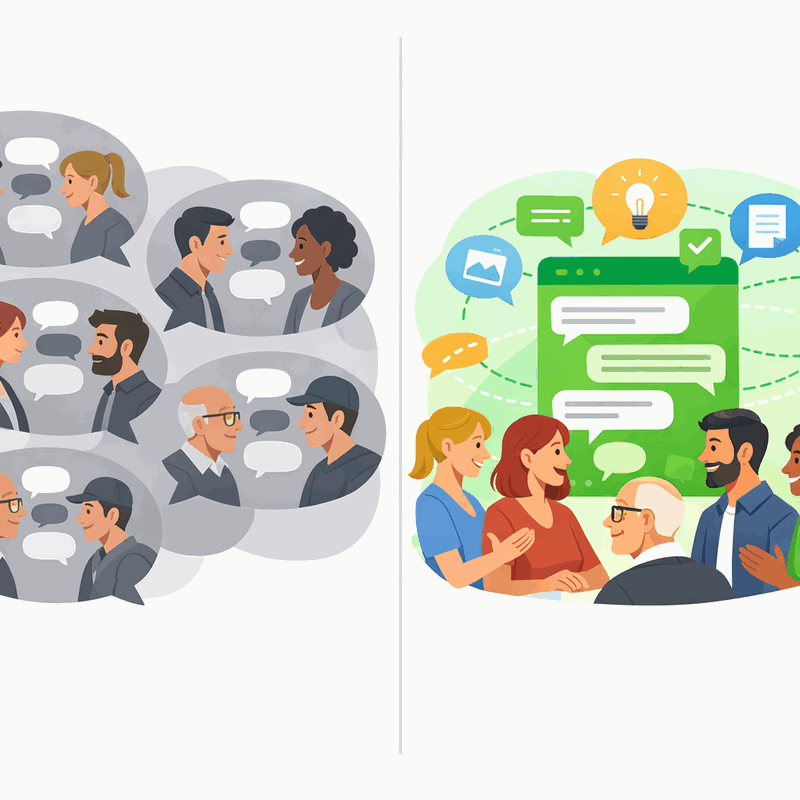
Most team chat tools default to private. You open Slack and the first thing you see is your DMs. The sidebar puts direct messages front and center. The quickest way to reach a colleague is a private thread with just the two of you. It feels natural. It feels efficient. It feels considerate — you don’t want to bother the whole channel with something that only concerns one person.
The result is predictable: important decisions get buried in private threads, the same question gets asked five different times in five different DMs, and new team members join to find a channel structure with no history, no context, and no clue about why things are the way they are. The team appears to be communicating. But they’re not actually aligned.
The Default-Private Problem
Most tools nudge you toward DMs as the path of least resistance. It feels easier. More intimate. Less formal than posting in a channel. When you’re not sure whether something is “important enough” for the whole team, the default is to keep it private. Over weeks and months, this behavior compounds. The team’s actual operating knowledge — decisions made, context shared, problems solved — gradually migrates out of shared spaces and into private threads that only two people can ever see.
The team-level cost of this is invisible in the short run and devastating in the long run. You don’t notice it happening. You just gradually find that no one knows what anyone else is working on, why certain decisions were made, or what the status of anything is — unless they ask someone directly, which starts the private DM cycle all over again.
What Gets Lost in DMs
The losses from private-first communication are specific and measurable. They fall into four categories:
- Context: Decisions made in private leave no searchable trail. Six months later, nobody remembers why the decision was made. The reasoning is gone. The alternatives considered are gone. What remains is just the outcome, with no way to understand it.
- Alignment: Different people get different versions of the same information. The PM explains the feature differently to the designer than to the engineer. The engineer gets a different picture than the QA person. Everyone is technically informed, but nobody has the same understanding.
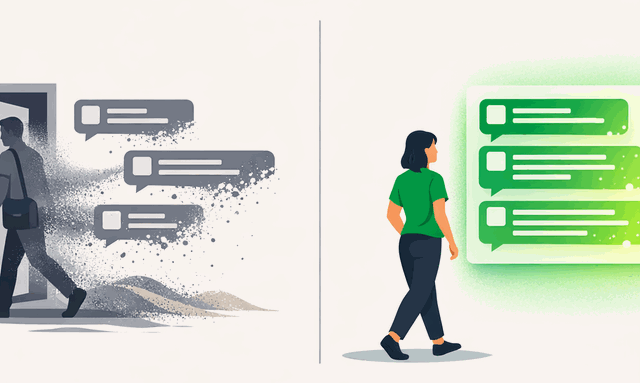
- Institutional knowledge: When someone leaves the company, their DMs go with them. Every conversation they had, every piece of context they shared, every decision they participated in — if it happened in a DM, it’s gone. The team has to reconstruct it from memory, which is unreliable and incomplete.
- Onboarding: New hires have no history to learn from. They join to find a clean slate of public channels with almost no history and a private DM ecosystem they have no access to. They have to spend their first weeks asking questions that were already answered — in private conversations they can never read.
The Duplication Tax
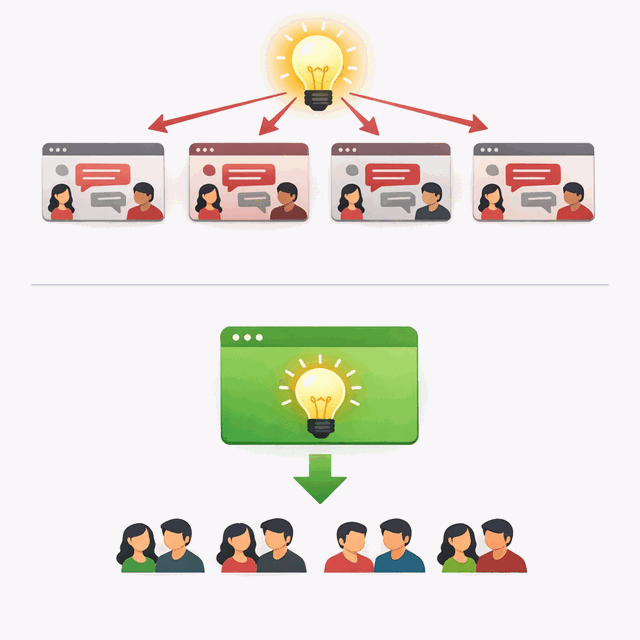
Here’s how duplication actually plays out. A designer and a product manager have a DM thread about the new onboarding flow. They discuss the rationale, explore a few options, and settle on an approach. The decision is made.
Then: the engineer who needs to implement it asks the PM. The PM explains it again. The marketing person needs to write copy and asks the designer. The designer explains it again. The CEO asks during the next all-hands what the thinking was. The PM explains it a third time. Three months later, a new hire asks why the onboarding flow works the way it does. Nobody remembers, and the original DM thread is buried under 10,000 other messages.
One decision. Communicated at least four times. Each retelling slightly different, slightly degraded. In a public channel, that conversation happens once. It’s searchable. It’s permanent. Anyone can read it, now and a year from now. The new hire finds it instantly. The CEO can review it before the all-hands without asking anyone. The duplication tax drops to zero.
Public Channels Create Automatic Documentation
One of the most underrated benefits of public-first communication is that it eliminates an entire category of work: documentation. Most teams know they should be maintaining a wiki or knowledge base. Most teams don’t, because it’s a separate task with no natural trigger. You make a decision, ship the feature, and move on. Updating the wiki happens “later,” which means never.
When decisions happen in public channels, the channel history is the documentation. You don’t need to update a separate system because the conversation already contains the reasoning, the alternatives considered, the people involved, and the outcome. It’s timestamped. It’s searchable. It’s automatically attributed to the right people.
A new hire who joins six months after a major architectural decision can find the exact channel thread where that decision was made, read the full discussion, understand the trade-offs, and get context that would have otherwise required a 30-minute meeting with three senior people. Public channels create organizational memory without any extra effort.
The Psychological Safety Angle
There’s a counterintuitive reason people default to DMs that’s worth addressing directly. It’s not laziness or malice. It’s discomfort. People don’t feel safe asking “dumb” questions in public. They’re worried about looking uninformed, bothering the whole team, or starting a debate they don’t want to have in front of everyone.
This is a legitimate concern, and it points to a real prerequisite for public-first communication: psychological safety. The tool can’t create that safety on its own. The culture has to support it. When leadership publicly admits uncertainty, asks questions they don’t know the answers to, and thanks people for raising concerns, it gives everyone on the team permission to do the same. When a senior engineer posts a question in a public channel that they could have figured out on their own in 20 minutes, they’re demonstrating that asking publicly is valued, not judged.
The goal isn’t to force every private thought into a public channel. Sensitive HR matters, personal feedback, and truly confidential business discussions have their place in private. The goal is to default to public for work discussions, decisions, and questions — and to build a culture where that default feels safe rather than exposing.
How Cleariest Is Built Around Public-First
Cleariest was designed from the ground up with transparency as a core value, not an afterthought. Channels default to public. The design language emphasizes shared spaces over private threads. The product philosophy is that good team communication is inherently shared — it creates a record, it invites participation, and it builds collective understanding rather than fragmented individual knowledge.
This isn’t just a product decision. It’s a statement about what we believe good team communication looks like: open by default, searchable, inclusive of everyone who needs the context, and preserved for anyone who needs it in the future. The teams we’ve worked with that have shifted to public-first consistently report fewer “wait, when did we decide that?” moments, smoother onboarding, and a stronger sense of collective ownership over decisions.
“The best thing about public channels isn’t transparency — it’s that I stopped getting DMs asking me to explain things that were already written down somewhere. The channel became the answer.”
Private messages will always have a place. But for the vast majority of team communication — questions, decisions, updates, discussions — public channels aren’t just better for the team. They’re better for you, because you only have to say something once.
Build a more transparent team
- Public-first channels by design — shared context for the whole team
- Searchable channel history replaces your wiki automatically
- New hires onboard faster with real conversation history to learn from
Related Reading
How to build a culture of shared knowledge that scales.
Onboarding New Team MembersWhy public channels make onboarding faster and less painful.
Public vs Private ChannelsWhen to use public channels and when private is the right call.
Transparent Collaboration Reduces FrictionHow openness at work reduces misalignment and unnecessary meetings.