The Hidden Cost of Context Switching: Why Your Team Gets Less Done Than You Think

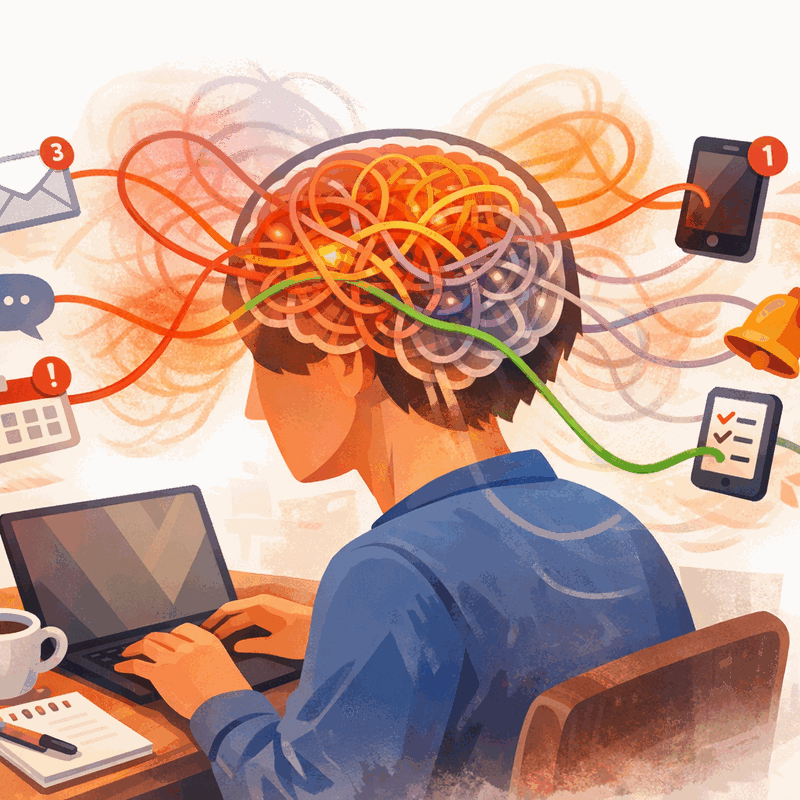
Most teams think their productivity problems come from bad planning, unclear goals, or not enough hours in the day. The real culprit is hiding in plain sight — every time someone opens Slack to check a message, glances at a notification, or switches between the design doc and the Jira ticket, they pay a hidden tax. Multiply that tax across a team, and the numbers become staggering. We’re not talking about minor inconveniences. We’re talking about a structural drain on your team’s most valuable resource: concentrated cognitive effort.
The Illusion of Multitasking
Most of us believe we are reasonably good at handling multiple things at once. We answer a Slack message mid-way through reviewing a pull request, we check email during a planning doc review, we glance at a notification while debugging a tricky issue. It feels productive. It feels like we’re staying on top of things.
Research from the American Psychological Association tells a different story. Their work on “task switching” shows that what we experience as multitasking is actually rapid, sequential task-switching — and each switch carries a measurable cost in time and accuracy. The APA estimates that this switching overhead can cost knowledge workers as much as 40% of their productive time. Not 5%. Not 10%. Forty percent.
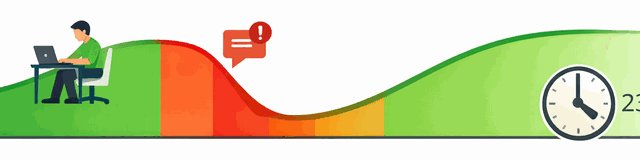
A complementary study from the University of California, Irvine adds even more alarming detail: after a workplace interruption, it takes an average of 23 minutes to fully regain deep focus on the original task. Not 2 minutes. Not even 10. Twenty-three minutes. And in a modern open-plan office (or a Slack-connected remote team), how often do interruptions happen? Multiple times per hour.
The brain isn’t actually switching between tasks instantaneously. It’s managing two competing activation patterns — what researchers call “goal shifting” (deciding to do something new) and “rule activation” (enabling the cognitive rules for the new task while suppressing the old ones). This process is metabolically expensive, slow relative to human perception, and degrades performance on both tasks involved.
The Math Your Team Has Never Done
Let’s make this concrete. Most teams never do this calculation because the cost is invisible — it doesn’t show up on any dashboard. But it should.
Assume a 5-person engineering team. Each person gets interrupted (by a chat notification, a @mention, a colleague asking a quick question, or their own compulsive notification-checking) an average of 6 times per day. That’s conservative; research suggests modern knowledge workers are interrupted far more frequently. Using the 23-minute recovery time from the UC Irvine study:
- 6 interruptions × 23 minutes recovery = 138 minutes per person per day of deep work capacity destroyed
- 138 minutes × 5 people = 690 minutes per day of lost deep work across the team — that’s 11.5 hours
- Over a 5-day work week: 57.5 hours of lost deep work per week for one small team
- A standard work week is 40 hours. Your team is losing the equivalent of more than one full-time employee’s entire week every single week to context switching
That employee isn’t on vacation. They’re sitting at their desk, appearing to work, answering messages, attending standups. But their most valuable cognitive output — the kind that ships features, solves hard problems, and creates competitive advantage — is being systematically eroded by the design of the tools they use every day.
Chat Tools as the #1 Source of Context Switching
This isn’t an accident. Slack, Microsoft Teams, and Discord are designed by some of the best product teams in the world, with one primary objective: engagement. Keep users in the product. Keep them checking. Keep them responding.
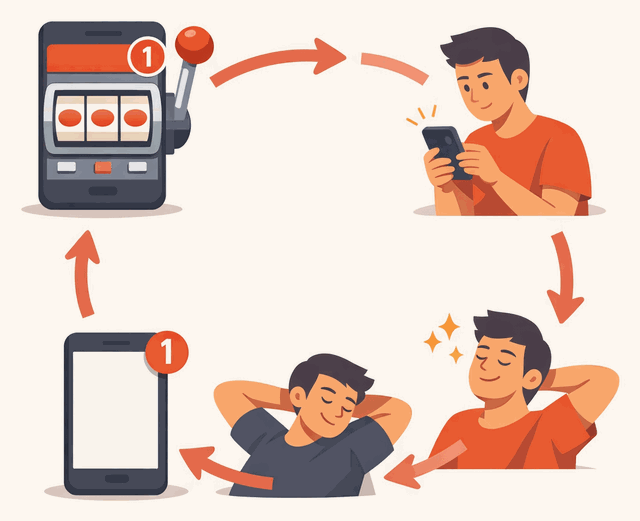
The mechanism is variable reward — the same psychological principle that makes slot machines so effective. You never know what the next message will contain. It might be trivial. It might be important. It might be funny. The uncertainty itself is compelling. Every unread badge is an invitation to switch context. Every “typing…” indicator is a reason to wait rather than focus. The tool is optimized for your attention, not your output.
The notification defaults in these tools are revealing. Slack notifies you by default for all direct messages and all @mentions. Teams notifies you for every message in channels you’re a member of. The out-of-the-box experience is maximum interruption. You have to actively fight the defaults to protect your focus — and most people never do.
The Attention Residue Problem
Researcher Sophie Leroy at the University of Washington introduced the concept of “attention residue” — and it makes the context switching problem even worse than the 23-minute figure suggests.
When you switch from Task A to Task B, part of your attention doesn’t actually make the switch. It stays attached to Task A, still processing it in the background, still holding open cognitive threads about where you left off, what still needs to be done, what you were in the middle of thinking. This residue degrades your performance on Task B even if you’re not consciously thinking about Task A.
The disturbing implication: even briefly checking a notification — even choosing not to respond — still fragments your focus. The moment you read a message, your brain starts processing it. Questions arise: do I need to respond? Is this urgent? What does this mean for what I’m working on? Those threads don’t close automatically. They run in the background and consume working memory that should be devoted to your actual work.
Putting your phone face-down isn’t a solution if you already read the notification. The damage is done at the point of exposure, not at the point of response.
Three Strategies to Reduce Context Switching
The good news is that context switching is a solvable problem. Not completely — some interruptions are unavoidable and genuinely important — but the vast majority of context switching is caused by tool defaults that can be changed, and communication norms that can be reshaped.
1. Notification batching. Instead of being available for messages continuously, designate specific times to check and respond: 9am, noon, and 3pm is a common pattern. Outside those windows, notifications are silenced. This doesn’t mean you become unresponsive — it means you batch your reactive work into defined slots so your focused work can happen uninterrupted. The key is that this needs to be a team norm, not just an individual choice. If everyone expects instant responses, the person batching notifications becomes a bottleneck. The norm change has to be collective.
2. Calendar time-blocking. Protect 2–3 hour focus blocks by marking them as “Busy” in your calendar and turning off all notifications during those windows. This is the individual-level intervention that actually works — but only when it’s paired with team norms that respect those blocks. A focus block that gets invaded by urgent pings every 20 minutes is worse than no focus block at all, because it creates the illusion of protected time without delivering it.
3. Tool design that batches interruptions for you. The most powerful intervention isn’t willpower — it’s tool design. Instead of relying on individuals to manage their own notification settings (which most people don’t do), use tools that are architected to deliver interruptions in batches rather than continuously. This shifts the burden from individual discipline to system design, which is far more reliable and equitable across a team.
How Cleariest’s Design Actively Reduces Context Switching
Cleariest is built around a simple premise: your team chat tool should protect your focus, not destroy it. The most concrete expression of this is Deep Work Mode.
When you activate Deep Work Mode, Cleariest batches all notifications until your focus session ends. You set the rules once — how long the session is, what types of alerts can break through (if any) — and the tool enforces them for you. No willpower required. No notification management. No deciding in real time whether a message is important enough to interrupt your work.
When the focus session ends, you don’t receive 47 individual pings that each demand processing. You get a digest: here’s what happened while you were focused, organized by channel and conversation thread. You can scan it in 2 minutes and respond to what matters. The attention residue problem is minimized because you’re processing messages in a controlled, batched way rather than having them injected into your workflow one at a time throughout the day.
The design philosophy extends to Cleariest’s public-first channel model. When conversations happen in public channels rather than DMs, context is preserved, fewer people need to be interrupted with direct messages, and the information stays searchable and accessible. A question answered once in a public channel doesn’t need to interrupt five different people in five different DMs.
The 40% productivity loss from context switching isn’t inevitable. It’s a design choice baked into the tools that most teams are using by default. Choosing tools — and communication norms — that respect your team’s attention is one of the highest-leverage investments a team can make.
Protect your team’s focus time
- Deep Work Mode batches all notifications until your focus session ends
- Public-first channels reduce DM interruptions across the whole team
- AI summaries let you catch up in minutes, not hours
Related Reading
How to protect your team’s focused work time with the right tooling.
Notification Fatigue SolutionsPractical ways to reduce notification overload for your whole team.
Reduce Slack NotificationsSteps to cut through the noise and reclaim your attention.
Deep Work in the Age of SlackCan knowledge workers still achieve deep focus in a Slack-dominated workplace?