5 Signs Your Team Chat Tool Is Hurting Your Productivity

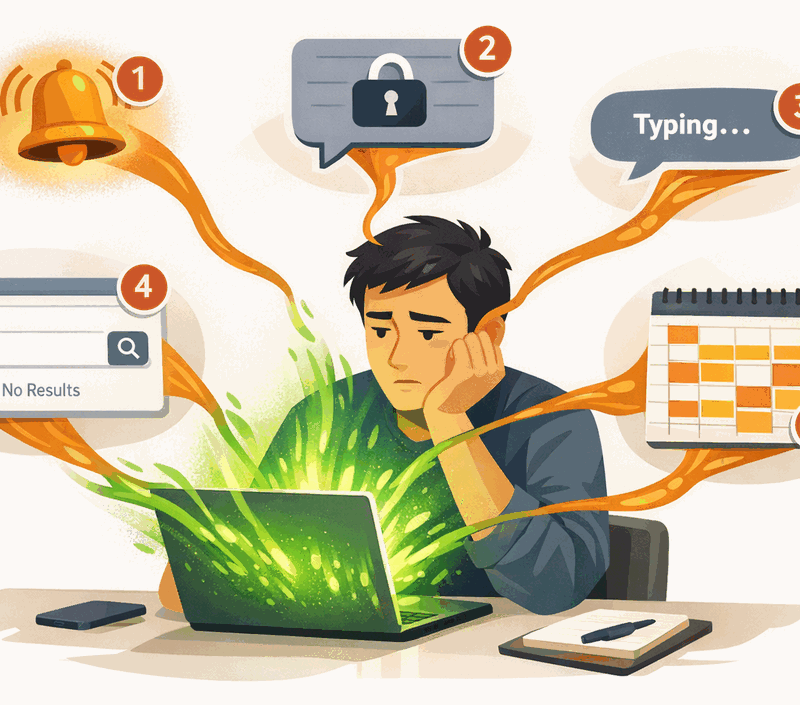
The tools we use to communicate shape the culture we build. A tool designed for engagement will produce an engagement-maximizing culture — one where people are always available, always reactive, and rarely in a state of deep focus. Most popular team chat tools were built by advertising-era product teams with one primary metric: time in app. That’s not a conspiracy. It’s just an incentive misalignment between the vendor’s interests and your team’s interests.
Here are five warning signs that your chat tool is working against you — and why each is a tool design problem, not a people problem.
Sign #1: You Feel Anxious When You Haven’t Checked Messages in 30 Minutes
If going 30 minutes without opening your chat app creates a low-grade sense of unease — a feeling that you might be missing something important, that someone might be waiting for you, that something might have gone wrong — that’s not a character flaw. It’s a conditioned response that your tool actively cultivated.
Real-time chat tools use notification mechanics, unread badges, and the social expectation of responsiveness to create a Pavlovian loop: message arrives, badge appears, you feel compelled to check, you respond, you feel the temporary relief of having resolved the pending item. The loop repeats dozens of times per day. Over weeks, the anxiety becomes the baseline. Not checking feels wrong because the tool has trained you to always be checking.
This is variable reward at work — the same mechanism behind social media feeds and slot machines. The unpredictability of what the next message will contain is more compelling than predictable rewards. If you feel anxious when you’re not checking, your tool has successfully made engagement the default state rather than focused work.
Sign #2: Important Decisions Get Made in DMs That Others Don’t Know About
If your team regularly makes decisions in private DM threads that the broader team doesn’t hear about until later — or sometimes never — your tool’s default-private orientation is creating knowledge silos. This isn’t about blame. When private messaging is the path of least resistance, people naturally gravitate toward it.
The cost is misalignment. The engineer who needs to implement a decision doesn’t know about it until it’s already been handed down as a finished directive, with no context on the reasoning. The new hire can’t understand why things work the way they do because the decisions that shaped the product are buried in private threads they can never access. The team has to hold multiple separate conversations about the same topic because there’s no canonical shared record.
A tool designed for team alignment would default to public. When the tool makes public communication as frictionless as private communication, teams naturally communicate more openly — not because they’re forced to, but because the default path leads there.

Sign #3: Your Team Expects Responses Within Minutes Even During Deep Work
If a teammate sends a message at 2pm on a Tuesday and expects a reply within 15 minutes, and if not getting that reply is considered a problem, your team has developed a culture of synchronous availability that the tool enabled and reinforced. This expectation is corrosive to deep work, because it makes focus blocks feel irresponsible. You can’t fully commit to 2 hours of uninterrupted work if you know a teammate is waiting for your response.
The expectation of instant response isn’t a team norm that emerged in a vacuum. It was shaped by the tool’s design: read receipts, typing indicators, online/offline status signals, and the implicit social contract of real-time chat all communicate that the expected response time is minutes, not hours. The tool trains teams to expect instant responsiveness, and then teams blame each other for failing to deliver it.
A tool built for deep work would make the opposite expectations feel natural. No typing indicators creating pressure to respond. Async by default. Urgency signals available for genuine emergencies, not deployed for every message. The culture should set the expectations — but the tool either supports that culture or works against it.
Sign #4: New Hires Have No Context on Past Decisions
When a new team member joins, how quickly can they understand why things are the way they are? If the honest answer is “they can’t, because everything important happened in DMs or in meetings with no notes,” your tool is failing the institutional memory test.
This is often written off as an onboarding problem — we need better documentation, a better wiki, better onboarding materials. But documentation that requires someone to intentionally create it will always lag behind reality. The solution isn’t more documentation overhead; it’s communication habits that produce documentation automatically, as a byproduct of normal work.
When important conversations happen in searchable public channels, those conversations are the documentation. New hires can read the thread where the API design was debated, the channel where the pricing model was decided, the post where the engineering team discussed the architectural trade-offs. This is only possible if the tool makes public communication the default — and only if the team has built the habit of working in those public spaces.
Sign #5: You’re Having Meetings to Communicate What Could Be Written
The “quick sync” is a telltale sign. If your response to a non-urgent question or a piece of information that needs to be shared is to schedule a meeting rather than write a clear message or post, your team has defaulted to the path of least effort — and that path is burning enormous amounts of collective time.
Meetings feel productive because they involve visible activity and the immediate satisfaction of a resolved conversation. But they carry heavy costs: preparation time, travel or setup time, the context switch cost of breaking focus blocks, the difficulty of partial attendance from distributed teammates, and the fact that meetings leave no written record unless someone explicitly takes notes.
A well-written message or channel post takes more effort upfront than scheduling a meeting. That upfront investment pays back many times over: the information is permanent, searchable, accessible to people who weren’t in the conversation, and requires no coordination overhead. If your team is defaulting to meetings for things that could be written, the root cause is often a tool that makes writing feel more effortful than it should be.
The Tool Shapes the Culture
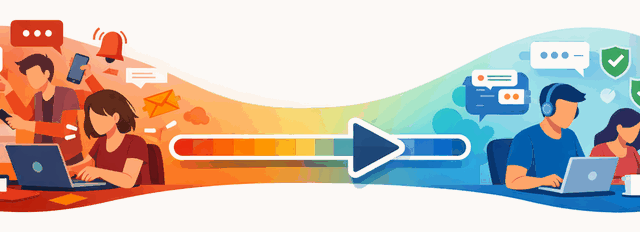
Every tool you give your team is a vote for a certain kind of culture. Tools designed for engagement produce reactive, always-on cultures. Tools designed for focus produce deliberate, async-first cultures. The remarkable thing is that most teams don’t make this choice consciously — they adopt whatever tool their industry uses by default and then wonder why their culture looks the way it does.
If you recognize two or more of the signs above in your team, the problem isn’t the people. It’s the design of the tools they’re using. Changing the tool changes the defaults. Changing the defaults changes the culture. And changing the culture is how you get the deep work time, the alignment, and the institutional memory that your team’s best work depends on.
A chat tool designed for focused work
- Deep Work Mode protects focus time — no anxiety-inducing badges
- Public-first channels so decisions stay visible to the whole team
- Async by design — no pressure for instant responses
Related Reading
Why simpler tools produce better team communication.
Notification Fatigue SolutionsHow to reduce notification overload without missing what matters.
The Hidden Cost of Context SwitchingThe research and math behind how interruptions destroy productivity.
Slack vs Teams vs CleariestHow the three tools compare on the dimensions that matter for focused teams.