Meeting Culture Is Broken. Here’s the Fix.


According to Microsoft’s Work Trend Index, the average knowledge worker now spends more than 57% of their work time communicating — in meetings, email, and chat — and less than 43% on focused, individual work. Meeting time specifically has more than doubled in the past five years. Teams using Microsoft Teams average over 3 hours per day in meetings, and the trend is still accelerating.
The paradox is maddening: we schedule meetings to get aligned so we can do the work. But back-to-back meetings mean we never have the uninterrupted time to do the work we just aligned on. We have meetings about our meetings. We schedule a sync to discuss the output of the last sync. And at the end of the day, the actual deliverable — the code, the design, the strategy document — is still waiting for the focus time that never came.
The Meeting Paradox
Meetings are the most expensive form of communication. They require every attendee to be present simultaneously, consuming their focused work time regardless of how much of the meeting is relevant to them. A one-hour meeting with six people isn’t a one-hour cost. It’s a six-hour cost, plus the context-switch cost for each person to get back into their work afterward.
And yet meetings feel productive. They involve visible activity: people talking, decisions getting made, heads nodding. There’s an immediate satisfaction to leaving a meeting feeling like you got aligned. The problem is that the alignment often doesn’t survive contact with reality. Without a written record, people leave the same meeting with different understandings of what was decided. Two weeks later, the same discussion happens again because nobody documented the outcome.
Why Meetings Multiply
Meetings propagate because the cost of scheduling one is invisible to the organizer. The cognitive cost of an interruption, the context-switch cost of breaking a focus block, the opportunity cost of lost deep work time — none of these show up when you click “Schedule Meeting.” The organizer sees a 30-minute slot on a calendar. The attendee loses the 30 minutes plus the recovery time on both sides.
The path of least resistance is also a factor. Typing out a clear, well-structured update is harder than saying “let’s sync.” Writing forces you to organize your thinking, anticipate questions, and be specific. A meeting lets you be fuzzy and resolve ambiguity in real time, which feels easier but produces lower-quality outcomes. The meeting is a shortcut that often creates more work downstream.
The Real Math
Let’s put a number on this. A knowledge worker at a $100,000 annual salary earns roughly $50 per hour in direct compensation (before employer costs, benefits, and overhead). At 15 hours per week in meetings, that’s $750 per week in direct salary cost — roughly $37,500 per year spent in meetings for a single person. For a 10-person team, that’s $375,000 per year. For meetings that are often poorly prepared, frequently unnecessary, and rarely documented.
This isn’t an argument that all meetings are bad. Some meetings create value that exceeds their cost: high-stakes decisions that benefit from real-time discussion, relationship-building conversations, creative brainstorming sessions where the back-and-forth itself generates the value. The argument is that most meetings aren’t this. Most meetings are status updates, quick syncs, and information transfers that could be handled more efficiently in writing.
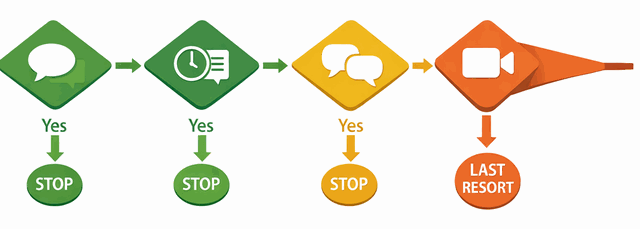
A Framework for Meeting Decisions
Before scheduling any meeting, work through this four-quadrant framework:
- Can this be a message? If the communication is one-directional — you have information to share and don’t need real-time discussion — a message in a public channel is more efficient. It’s persistent, searchable, and doesn’t consume anyone’s calendar.
- Can this be async? If you need input from multiple people but don’t need it simultaneously, an async thread works better than a meeting. Post the question or document, give people 24–48 hours to respond thoughtfully, and synthesize the input. The quality of async responses is usually higher than real-time discussion because people have time to think.
- Does this need real-time discussion? Some decisions genuinely benefit from back-and-forth in real time — where the conversation itself generates the solution rather than just communicating a pre-formed one. If this is the case, a meeting may be warranted. But challenge this assumption explicitly. Most “we need to discuss this” situations are actually “I haven’t thought this through yet and I want to process it out loud.”
- Does this need video? Even if real-time discussion is needed, voice is often sufficient. Video adds value for relationship-building, emotional conversations, and creative sessions where visual collaboration matters. For most working meetings, it’s optional overhead.
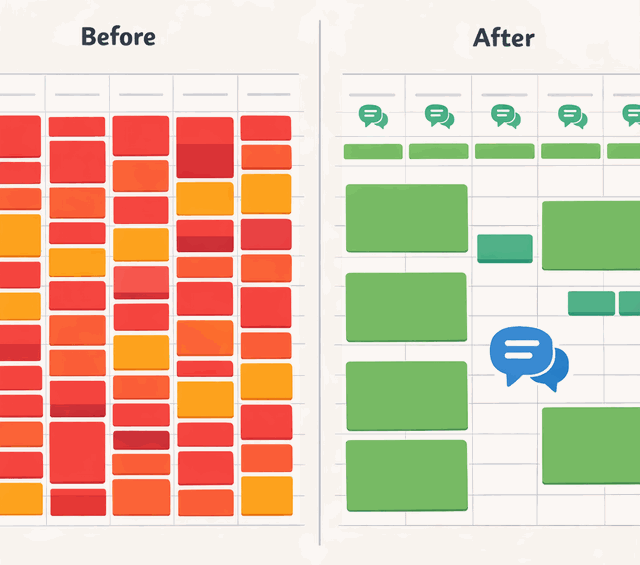
The Async Replacements for Common Meetings
The most common meeting types have clear async replacements that work better for distributed teams and preserve more focused work time:
Daily standup → Async standup post. Each team member writes a brief post in a dedicated channel: what they completed yesterday, what they’re working on today, any blockers. A template helps: “Done: [X]. Today: [Y]. Blocked by: [Z or nothing].” The whole team gets visibility without a mandatory 15-minute meeting. Team members in different time zones can post asynchronously. The written record is searchable and useful for status updates with stakeholders.
Status update meeting → Channel post with structured template. Instead of a weekly meeting where each person gives an update, create a “#weekly-updates” channel where everyone posts on Friday afternoon. Same information, no scheduling required, no one waiting for others to finish talking. Everyone reads at their own pace.
“Quick sync” → Public channel thread. Most “quick syncs” are a question that needs an answer. Post the question in the relevant public channel. Tag the person if needed. Get the answer in writing, where it’s visible to the whole team and searchable forever. The “quick sync” that would have taken 20 minutes of both people’s time takes 3 minutes of asynchronous writing.
Sprint retrospective → Async channel thread with prompts. Post three questions in the team channel 48 hours before the end of the sprint: “What went well? What didn’t? What should we change?” Give people time to respond thoughtfully. Synthesize the responses in a follow-up post. Reserve the synchronous retro session for the 10% of items that genuinely benefit from real-time discussion.
What Happens When You Default to Async
Teams that shift to async-first communication consistently report three changes. First, writing quality improves. When written communication is the norm, people get better at writing. They learn to organize their thinking, provide context, and anticipate questions. The quality of decisions improves because the thinking behind them is made explicit rather than remaining fuzzy.
Second, decisions have a paper trail. Every async discussion produces a written record automatically. Six months later, when someone asks “why did we decide this?”, the answer is searchable. New team members can onboard from the history of how things were decided, not just the outcomes.
Third, repeat conversations decrease. The most common trigger for redundant meetings is that previous decisions were communicated verbally and therefore lost. Async communication eliminates this by making the record of decisions persistent and accessible. The question gets asked once, answered in writing, and never needs to be re-litigated.
The Transition Plan
Culture change is gradual. Trying to eliminate all meetings simultaneously will create anxiety and resistance. A more effective approach is incremental:
Start with one meeting type. The daily standup is usually the easiest first target because it’s routine, low-stakes, and has a clear async equivalent. Run the async standup for 4 weeks. At the end, ask the team: was the async version better, worse, or the same as the synchronous one? If the answer is “better or the same,” you’ve just saved 5 hours per week of meeting time per person. Make it permanent.
Then move to the next meeting type. Status updates. Project syncs. Weekly check-ins. Each one that shifts to async creates more protected focus time and reinforces the cultural norm that written communication is the default. The synchronous meetings that remain become more valuable precisely because they’re rarer and reserved for situations that genuinely benefit from real-time discussion.
The goal isn’t zero meetings. It’s meetings that earn their place in the calendar — because they create value that couldn’t be created any other way.
Replace your standups with async communication
- Public channels with searchable history replace your status meetings
- AI summaries keep you informed without reading every thread
- Deep Work Mode protects the focus time you win back from fewer meetings
Related Reading
How to cut meeting time in half without losing alignment.
Async Standup CommunicationReplace your daily standup with async posts that work better.
Remote Team CommunicationBest practices for distributed teams that need to stay aligned.
Remote Team Best Practices for 20268 concrete practices for distributed teams that actually work.