Open Source Team Chat: Self-Hosted vs Managed Solutions
The appeal of open source team chat is real: full data control, no per-seat pricing, and the freedom to customise everything. But the reality is more nuanced. Self-hosting a chat platform requires infrastructure, DevOps time, and ongoing security responsibility that most teams underestimate. This guide gives you an honest picture of both paths.
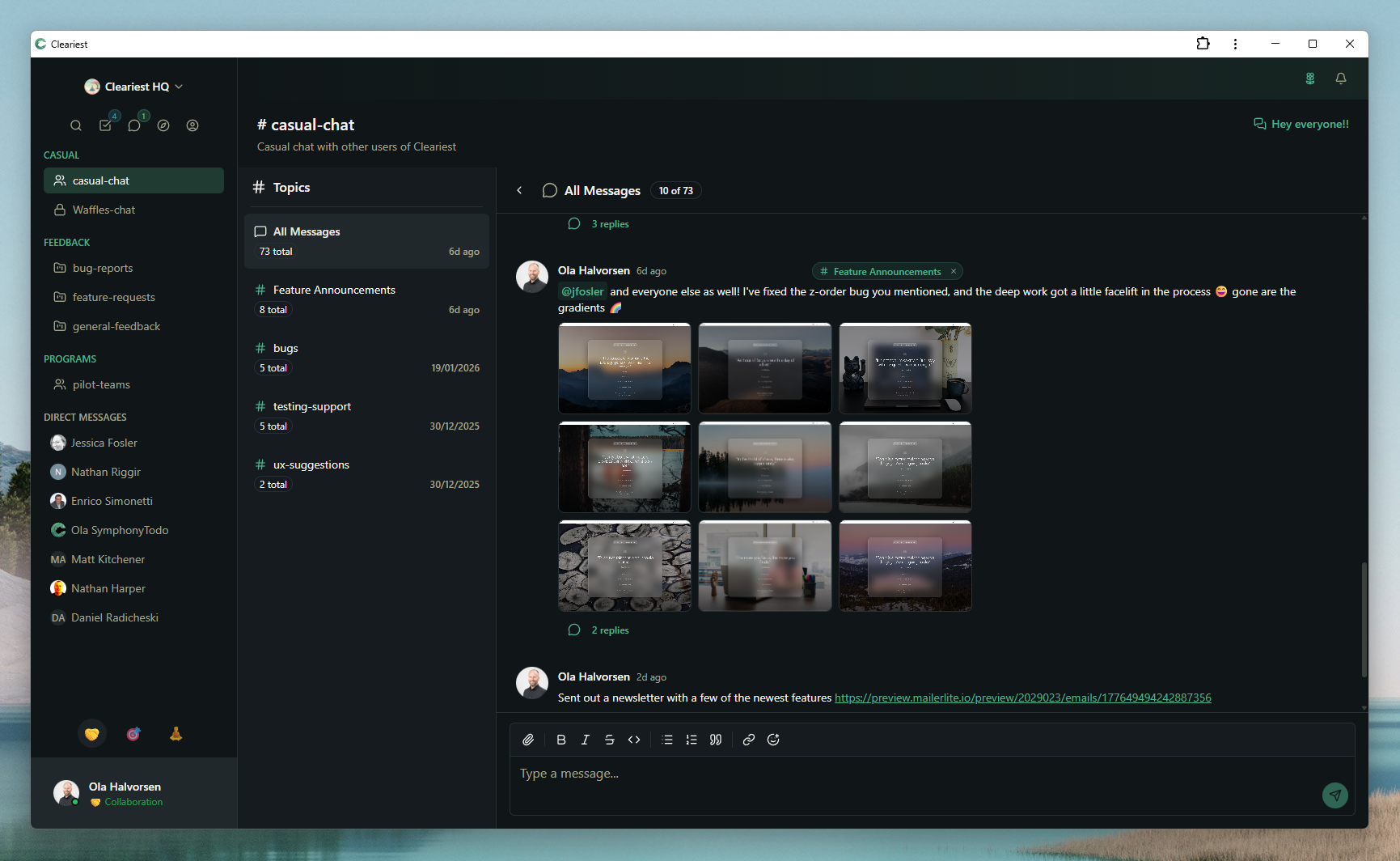
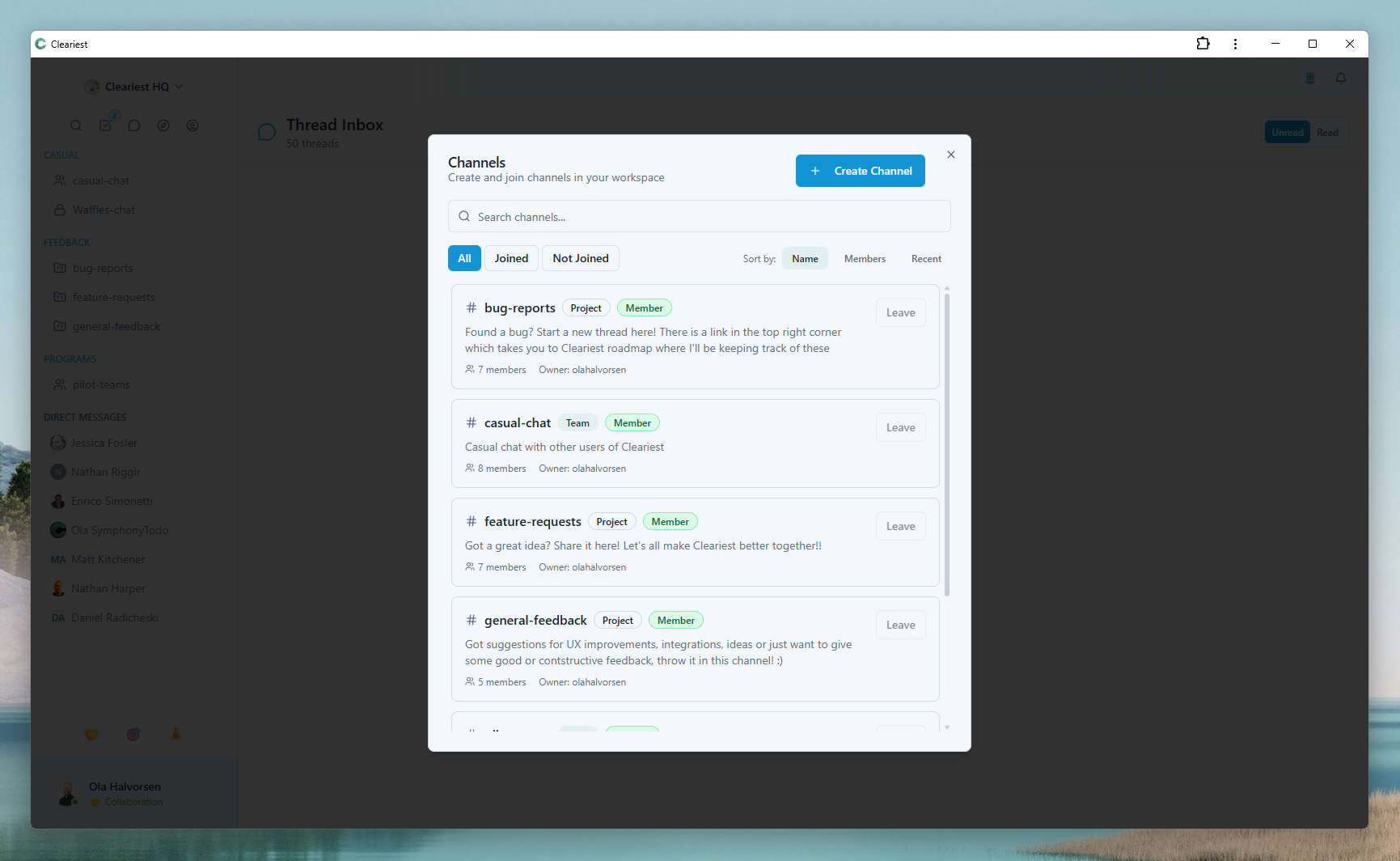
Cleariest's managed platform: organized topics and easy channel discovery — no self-hosting required.
Why Teams Consider Open Source
There are three legitimate reasons to consider self-hosting an open source chat platform, and they are all worth taking seriously.
The first is data sovereignty. Some organisations — particularly those handling sensitive government data, certain healthcare information, or operating in jurisdictions with strict data residency requirements — need their data to never leave a specific server or geographic region. A managed SaaS product may not be able to guarantee that, while self-hosting can.
The second is cost at scale. If you have 500 users on Slack at $7.25/user/month, that is $3,625 per month — $43,500 per year. At that scale, paying a DevOps engineer to maintain a self-hosted Rocket.Chat or Mattermost instance might genuinely be cheaper. The cost calculation only works in open source's favour at larger team sizes, though.
The third is customisation. Open source platforms can be modified, extended, and integrated with internal systems in ways that closed-source SaaS products cannot. For teams building proprietary internal tooling or needing deep custom integrations, this flexibility is valuable. For most teams, however, the default feature sets of managed tools are sufficient.
The Hidden Costs of Self-Hosting
The phrase "open source is free" is technically true but practically misleading. The software costs nothing; operating it reliably costs quite a lot.
Server Infrastructure: $20–100+/month
A minimal Rocket.Chat or Mattermost installation requires at least 2GB RAM and a database server. On AWS, Google Cloud, or DigitalOcean, that runs $20–40/month for a small deployment. Add backups, redundancy, and a separate database instance, and you are at $60–100/month before counting any labour. For teams over 50 users, you will need a more capable server tier.
DevOps Time: 5–20 Hours/Month
Initial setup takes 4–16 hours depending on the platform and your infrastructure. Ongoing maintenance includes applying security patches, updating the platform when new versions release, monitoring server health, managing SSL certificate renewals, and debugging issues when something breaks. This is not a one-time cost — it is a recurring time commitment that falls on someone in your team.
Security Responsibility
When you self-host, you own the security. That means monitoring CVE disclosures for the platform, applying patches promptly, managing firewall rules, configuring rate limiting to prevent abuse, and ensuring your server is not vulnerable to the latest exploits. A misconfigured self-hosted server exposing your team's private communications is a real risk — and one that a professional managed service with a dedicated security team handles for you.
No Built-in AI Features
Open source chat platforms are generally behind on AI features. Rocket.Chat has begun adding AI integrations, but they require additional configuration, third-party API keys, and additional cost. Mattermost, Zulip, and Element do not have built-in AI summaries comparable to what Cleariest ships by default. If AI-assisted catch-up is important to your team, self-hosted open source options require significant additional work.
Version Upgrades Can Break Customisations
If you have customised your instance — added custom plugins, modified themes, or integrated with internal systems — major version upgrades can break those customisations. Testing upgrades, maintaining compatibility with custom code, and rolling back when things break is a real operational burden. Many self-hosted teams end up running outdated versions of their chat platform because upgrading is too risky.
The True Cost Calculation
Let's do the math honestly for a 20-person startup considering self-hosting Rocket.Chat:
Self-Hosted Rocket.Chat (Monthly)
For a 20-person team
Compare that to Cleariest starting at $29/month per workspace (Calm plan) or Slack Pro at $7.25/user/month ($145/month for 20 users). Cleariest's flat-rate pricing is significantly cheaper than per-seat tools or the hidden labor costs of self-hosting.
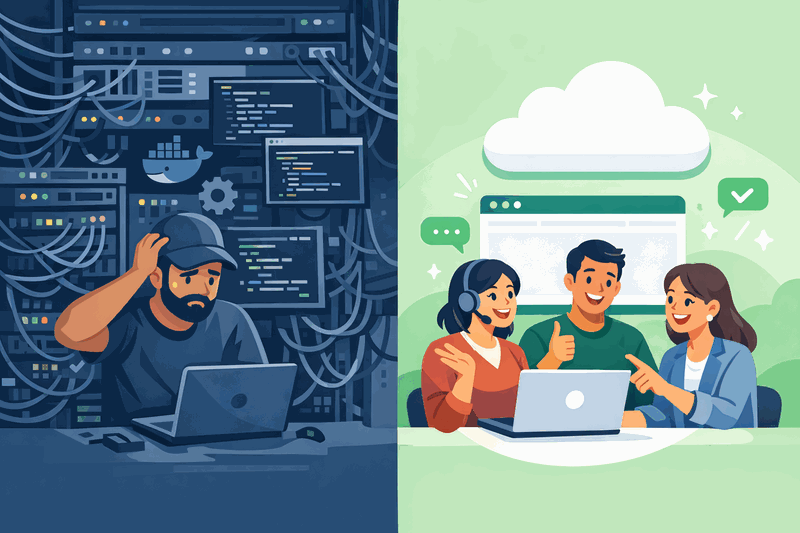
The math changes at much larger team sizes or if you have DevOps resources that are already paid for and underutilised. But for most teams under 200 people without a dedicated infrastructure team, the "free" in open source team chat is largely illusory.
Open Source Options Compared
There are four credible open source team chat platforms worth knowing about. Here is an honest assessment of each.
| Tool | Setup Complexity | Key Strength | Key Weakness |
|---|---|---|---|
| Rocket.Chat | High | Feature-rich, most Slack-like experience | Heavy, resource-intensive, complex admin |
| Mattermost | High | Security-focused, popular with DevOps teams | Requires significant ongoing DevOps effort |
| Zulip | Medium | Unique thread-first model, great search | Niche UX model, steep initial learning curve |
| Element / Matrix | Very High | Federated, maximum privacy control | Extremely complex setup; niche use cases |
Rocket.Chat
The most feature-complete open source option. It closely resembles Slack and has channels, DMs, threads, file sharing, and a growing marketplace of integrations. The tradeoff is resource requirements — Rocket.Chat needs more RAM and CPU than its competitors, and the admin panel is complex. Managed cloud hosting options exist but add cost.
Mattermost
Particularly popular with DevOps, security, and government teams. Mattermost has a one-click Docker install that is among the best in the category, and its documentation is thorough. The commercial team edition adds more features. If you need a self-hosted option that your IT or security team will be comfortable supporting, Mattermost is typically the recommendation.
Zulip
Zulip takes a fundamentally different approach: every message belongs to a topic within a stream (channel). This threading-first model can be excellent for async teams who want organised conversations, but it requires a mental model shift from Slack/Teams users. Once teams adapt, many find it very productive. The learning curve is real, though.
Element / Matrix
Matrix is a federated messaging protocol; Element is the main client. This is the maximum-privacy option — you can run your own server and federate with other Matrix servers worldwide. The complexity is proportionally high. This is best suited for technically sophisticated teams with specific federation requirements, not typical work teams looking for a Slack alternative.
Where Cleariest Fits
Cleariest occupies the space between "free but complex self-hosted" and "expensive but polished enterprise SaaS." It is a managed product, which means no infrastructure to maintain, no security patches to apply, and no DevOps time required. You pay for the value of someone else running the infrastructure reliably.
For teams under 10 members, Cleariest is genuinely free with no message limits. This covers a large portion of startups and small teams who would otherwise feel forced to choose between Slack's 90-day history limit and the complexity of self-hosting. At zero cost, with no infrastructure overhead and with Deep Work Mode and AI summaries included, the value proposition is straightforward.
Managed Security
We handle security patches, encryption, and infrastructure. You focus on your work.
AI Included
Built-in AI message summaries with no extra configuration or API keys required.
Deep Work Mode
Focus protection that open source tools simply do not offer out of the box.
Decision Framework
Choose self-hosted open source if…
- You have strict data residency requirements (government, healthcare)
- You have 200+ users where per-seat costs become significant
- You have dedicated DevOps/sysadmin resources already paid for
- You need deep customisation or internal system integration
- Policy prohibits any third-party SaaS for communication
Choose Cleariest if…
- You want zero infrastructure overhead
- Your team is under 200 people without dedicated DevOps
- You want AI summaries and Deep Work Mode out of the box
- Free tier (up to 10 members) covers your current team size
- You prefer focus and transparency over maximum customisation
Related Reading
Frequently Asked Questions
Is Rocket.Chat really free?
The Rocket.Chat software is open source and free to download. However, you still need to pay for server infrastructure (typically $20–100/month minimum on cloud providers), plus factor in the DevOps time required for installation, configuration, maintenance, and updates. For many teams, the total cost of ownership exceeds what they would pay for a managed solution. Rocket.Chat also offers a managed cloud version with per-seat pricing if you prefer not to self-host.
Can I trust a managed tool with my team's conversations?
Cleariest uses industry-standard security practices including encryption at rest and in transit, secure authentication, and responsible data handling. For most teams, a well-run managed service is actually more secure than a self-hosted instance managed by someone without dedicated security expertise. The risk of a misconfigured self-hosted server is often higher than the risk of using a professional managed service.
What open source tool is easiest to self-host?
Mattermost has the most mature self-hosting experience with good documentation and a straightforward Docker-based install. Zulip is also quite accessible for technical teams and has a well-maintained self-hosting guide. Rocket.Chat is feature-rich but heavier and more complex to configure correctly. Element/Matrix has the steepest learning curve due to its federated architecture and is only recommended for teams with specific federation requirements.
Does Cleariest offer data export?
Yes, teams can export their data from Cleariest. We believe your data belongs to you. If you ever decide to leave or move to a self-hosted solution, you can take your message history with you. We will never hold your data hostage.
Skip the Infrastructure Overhead
Cleariest is free for teams up to 10 members. No servers to manage, no security patches to apply, no DevOps time required. Deep Work Mode and AI summaries included.